



IDH2
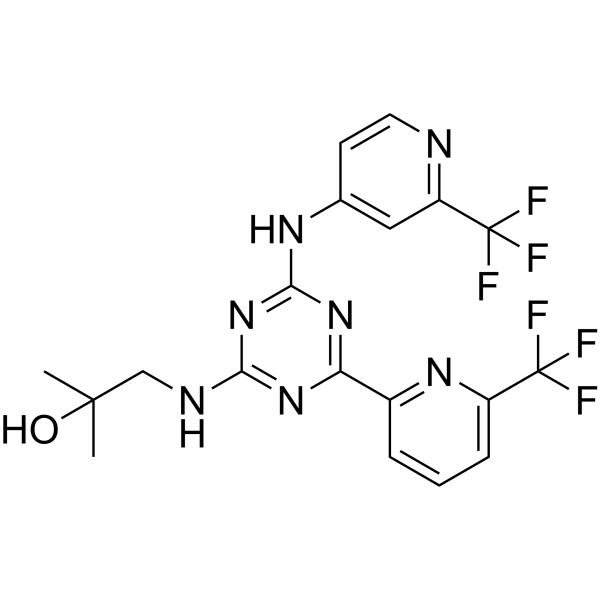
IDH2 (isocitrate dehydrogenase 2) encodes a mitochondrial NADP+-dependent isocitrate dehydrogenase that catalyzes the oxidative decarboxylation of isocitrate to 2-oxoglutarate while generating NADPH, thereby supporting mitochondrial metabolism and redox homeostasis[1][2]. Mechanistically, IDH2 participates in intermediary metabolism through the conversion of isocitrate to 2-oxoglutarate, linking cellular energy metabolism with NADPH production required for biosynthetic and antioxidant processes[2]. In disease settings, recurrent IDH2 mutations confer a neomorphic enzymatic activity that promotes the production of the oncometabolite 2-hydroxyglutarate (2-HG), which is associated with epigenetic dysregulation and impaired cellular differentiation in malignancies, particularly acute myeloid leukemia (AML)[3][4][5]. Therefore, mutant IDH2 has become an important molecular target in cancer research and precision oncology[3][5]. Compared with related isoforms, IDH1 and IDH2 both utilize NADP+ and catalyze the same biochemical reaction, whereas IDH2 is localized to mitochondria, distinguishing its metabolic context from the cytosolic IDH1 isoform[2][5]. For experimental and translational applications, enasidenib is a selective small-molecule inhibitor of mutant IDH2 that reduces 2-HG levels and promotes myeloid differentiation, providing a widely used pharmacological tool for investigating mutant IDH2 biology and therapeutic response mechanisms in AML models[3][5][6].
References:
- [1]. IDH2 gene information from NCBI.
- [2]. Cadoux-Hudson T, et al. Isocitrate dehydrogenase gene variants in cancer and their clinical significance. Biochem Soc Trans. 2021;49(6):2561-2572.
- [3]. Amaya ML, et al. Targeting the IDH2 Pathway in Acute Myeloid Leukemia. Clin Cancer Res. 2018 Oct 15;24(20):4931-4936. [Content Brief]
- [4]. Guo J, et al. Biological Roles and Therapeutic Applications of IDH2 Mutations in Human Cancer. Front Oncol. 2021 Apr 26;11:644857. [Content Brief]
- [5]. Wikipedia.
- [6]. Wikipedia.
All Product Categories
-
IDH2 Related Products (10)
Related Products (10)

-
Vorasidenib
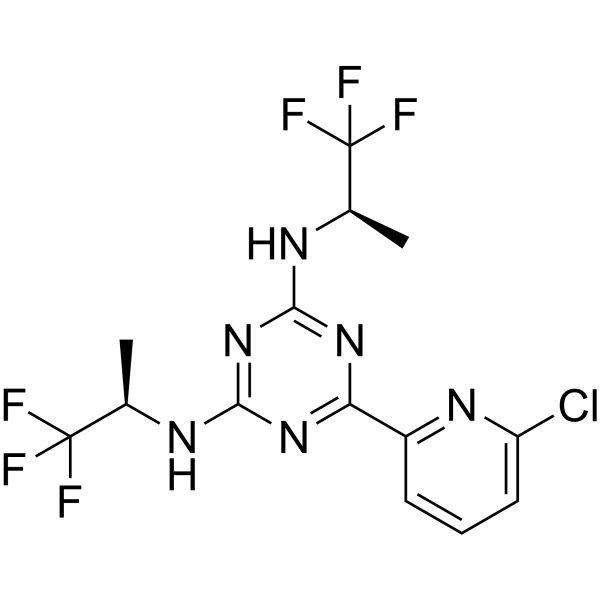 0 ImagesSynonyms: AG-881Vorasidenib (AG-881) is an orally available, brain penetrant second-generation dual mutant isocitrate dehydrogenases 1 and 2 (mIDH1/2) inhibitor. Vorasidenib (AG-881) exhibits nanomolar inhibition of (D)-2-hydroxyglutarate (D-2-HG), and the IC50 ranges of 0.04~22 nM against IDH1 R132C, IDH1 R132G, IDH1 R132H and IDH1 R132S and 7~14 nM against IDH2 R140Q and 130 nM against IDH2 R172K. Vorasidenib can be used for the study of grade 2 astrocytoma or oligodendroglioma with a susceptible IDH1/2 mutation.
-
Enasidenib mesylate
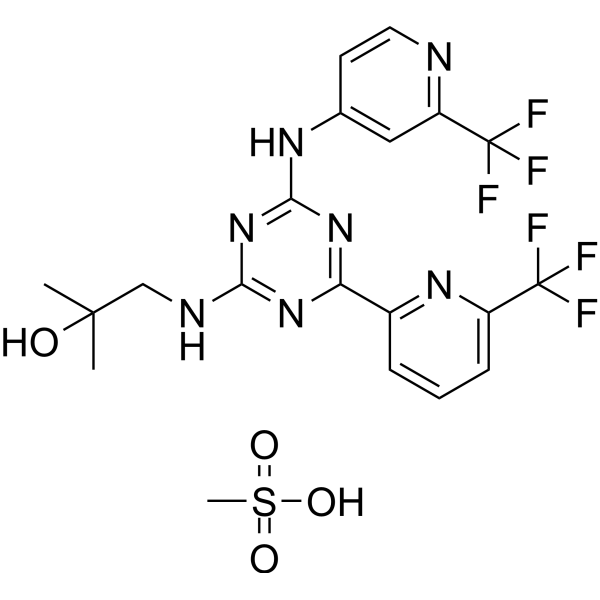 0 ImagesSynonyms: AG-221 mesylate
-
Crelosidenib
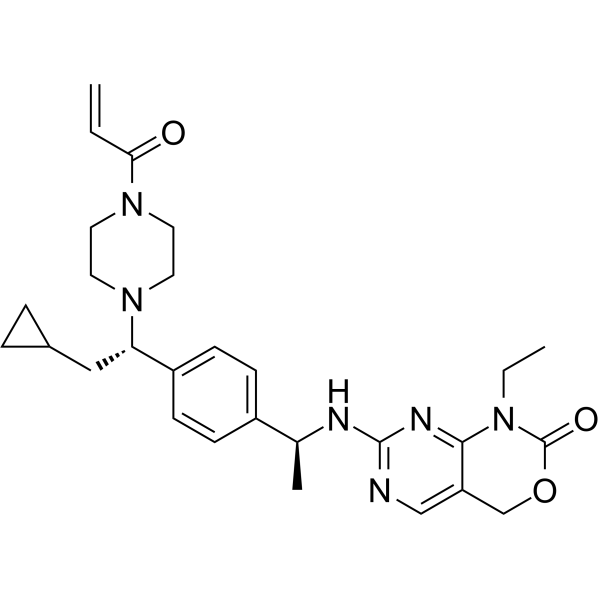 0 ImagesCat. No.: HY-131312CAS No.: 2230263-60-0Synonyms: LY3410738; Mutant IDH1-IN-6Mutant IDH1-IN-6 is a potent, selective and orally active mutant isocitrate dehydrogenase (IDH) inhibitor with IC50s of 6.27 nM, 3.71 nM, 36.9 nM and 11.5 nM for IDH1 R132H, IDH1 R132C, IDH2 R140Q and IDH2 R172K mutant enzymes, respectively. Mutant IDH1-IN-6 is less active at inhibiting the IDH wild-type enzymes.
-
IHMT-IDH1-053
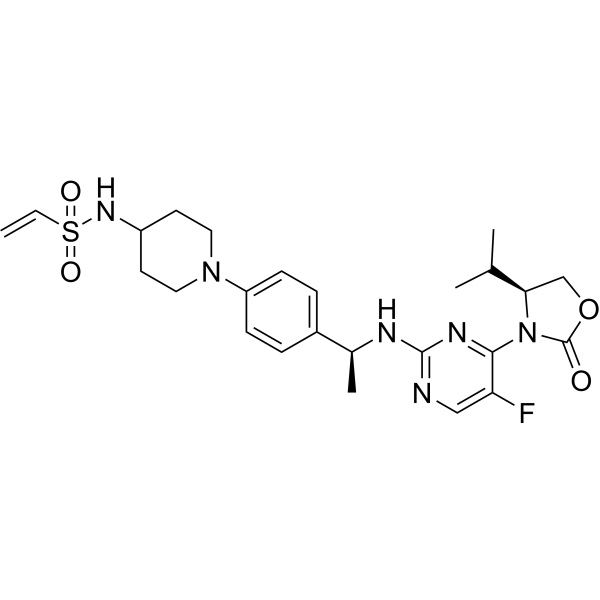 0 ImagesCat. No.: HY-149359CAS No.: 3049485-80-2IHMT-IDH1-053 (compound 16) is a highly selectivity and irreversible IDH1-mutant inhibitor with an IC50 of 4.7 nM for IDH1 R132H. IHMT-IDH1-053 displays high selectivity against IDH1 mutants over IDH1 wt and IDH2 wt/mutants. IHMT-IDH1-053 inhibits 2-hydroxyglutarate (2-HG) production in IDH1 R132H mutant transfected 293T cells (IC50=28 nM). IHMT-IDH1-053 binds to the IDH1 R132H protein in the allosteric pocket adjacent to the NAPDH binding pocket through a covalent bond with residue Cys269. IHMT-IDH1-053 inhibits the proliferation of HT1080 cell line and primary AML cells which both bear IDH1 R132 mutants.
-
CP-17
 0 ImagesCat. No.: HY-145743CAS No.: 1111233-06-7CP-17 is a potent and selective IDH2/R140Q inhibitor with an IC50 of 40.75 nM. CP-17 exhibits excellent selectivity of >55-fold against the wild-type IDH2. CP-17 exhibits robust D-2-HG suppression activity in TF-1 (IDH2/R140Q) cells and reverses the cellular differentiation block induced by the R140Q mutation. CP-17 can be used for acute myeloid leukemia (AML) research.
-
TQ05310
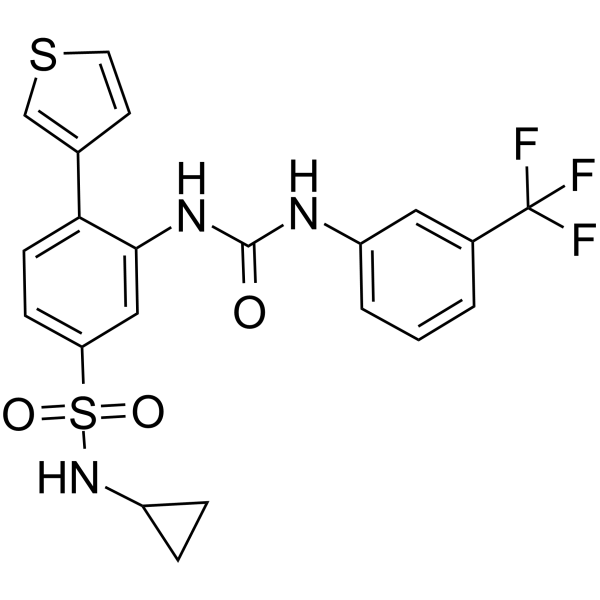
 0 ImagesCat. No.: HY-164542CAS No.: 2071196-10-4TQ05310 is an orally available inhibitor of IDH2 mutants, targeting both IDH2-R140Q (IC50=136.9 nM) and IDH2-R172K (IC50=37.9 nM) mutants. TQ05310 inhibits the production of 2-hydroxyglutarate (2-HG) and induces differentiation of cells expressing IDH2-R140Q and IDH2-R172K by inhibiting the enzymatic activity of mutant IDH2. TQ05310 can be used for the study of acute myeloid leukemia.
-
BRD2879
 0 ImagesCat. No.: HY-120765CAS No.: 1304750-47-7BRD2879 is a potent IDH1-R132H inhibitor with IC50 values of 0.05, 2.5, >20, >20 µM for IDH1-R132H, IDH1-R132C, IDH1-WT, IDH2-R140Q, respectively. BRD2879 reduces (R)-2-hydroxyglutarate (R-2HG) levels.
-
Crelosidenib gentisate
 0 ImagesCat. No.: HY-131312ACAS No.: 2759438-85-0Synonyms: LY3410738 gentisate; Mutant IDH1-IN-6 gentisateCrelosidenib (gentisate) is a potent, selective and orally active mutant isocitrate dehydrogenase (IDH) inhibitor with IC50 of 6.27 nM, 3.71 nM, 36.9 nM and 11.5 nM for IDH1 R132H, IDH1 R132C, IDH2 R140Q and IDH2 R172K mutant enzymes, respectively. Crelosidenib (gentisate) is less active at inhibiting the IDH wild-type enzymes.



